
Declining dissolved oxygen (or ‘deoxygenation’) is an increasing and concerning phenomenon in many freshwater, coastal and oceanic environments. Critical for the survival and functioning of all living organisms and ecosystems, oxygen levels are impacted by a wide range of factors. Warmer water holds less oxygen, and ocean warming can also result in changes in circulation and stratification that prevent oxygen-rich surface water from mixing with deeper water. In addition, nutrient pollution from increased land use often leads to increased primary productivity and oxygen consumption.
As these drivers of deoxygenation can take decades to reverse, some scientists and managers are turning to the field of engineering to provide an interim remediation option.
Engineered oxygen supply – or EOS – describes a range of technologies designed to increase oxygen availability in waterbodies, from lakes and reservoirs to estuaries and oceans. A recent systematic review published in Ecological Engineering of the use of EOS techniques in marine environments by IMAS PhD researcher, Jimmy Hortle, examined over 200 EOS studies from around the world to understand their effectiveness and distil learnings for their future application.
Mr Hortle says the review findings suggest that EOS could become an important tool for restoring oxygen-depleted waters.
“It's likely we will see more marine examples of EOS in the future, however, there is a lot to learn before it can be considered a solution for the ocean at large."
Although less common than in freshwater environments, marine applications of EOS have increased in recent decades and represent an emerging field. Most of these applications have occurred in relatively contained environments, such as stratified estuaries and semi-enclosed basins, rather than the open ocean.
Increasing oxygen levels can be achieved through a wide range of techniques. Some approaches work by mixing the water, bringing oxygen-rich surface water down into deeper areas. Others directly add oxygen, using air or pure oxygen delivered through systems such as diffusers.
This distinction is important. Mixing doesn’t actually create more oxygen. Instead, it redistributes oxygen that is already present in the water. Direct oxygen addition, on the other hand, can increase the total amount of oxygen available, making it a more promising option for broader marine applications.
The review demonstrates that, historically, many EOS studies have had narrower objectives, targeting certain processes and species, such as suppressing harmful algal blooms, shifting sediment processes and improving habitat for benthic fauna and fish. As a result, associated monitoring programs and measures of success have been limited in their scope, often involving measuring oxygen concentrations without examining what is happening to the broader ecosystem over meaningful periods of time. Patchy monitoring of ecological responses during past applications of EOS limits our understanding of the effectiveness of EOS as a longer-term ecosystem restoration tool.
For contemporary and prospective marine applications of EOS, the end goal is typically a healthy, functioning ecosystem and, as such, any measure of success requires monitoring the broader physical, chemical and biological environment. The review emphasised the need for integrated measures of ecosystem response conducted over longer time periods and wider spatial scales to determine the ability of EOS to truly enable ecosystem recovery.
“We’ve proposed a monitoring framework to accompany future EOS interventions, so that we can get a more consistent and thorough picture of the effectiveness of this approach moving forward”, Mr Hortle says.

The large variation in characteristics of marine systems, including hydrodynamics, stratification (density layering of the water column) and size means that no single EOS technique is suitable across all coastal and ocean settings. Each EOS technique also comes with its own operational and economic constraints. As a result, when EOS is considered, the technique must be matched to the characteristics of the system.
By learning from past experiences, the review cautions that in order for EOS to be effective and to prevent unintended environmental harm, the drivers of low oxygen levels in the particular context need to be well understood, the right EOS technique needs to be chosen for that context, and its operating parameters need to be scaled correctly.
Depending on a system’s drivers of deoxygenation, EOS may best sit within a suite of management actions, which also aim to reduce nutrient inputs and restore key habitats. In the future, it may be considered another tool in the restoration toolbox, particularly in areas where oxygen loss has already occurred and where natural recovery is slow or unlikely.
In an example closer to home, EOS techniques have been trialled and more recently upscaled in an effort to combat low oxygen levels in Macquarie Harbour, on Tasmania’s west coast. Deoxygenation in Macquarie Harbour is linked to a combination of aquaculture, hydroelectric dams and climate change, and is considered a key risk factor for the future of the endangered Maugean skate, endemic to the harbour.
The initial pilot trial commenced in January 2024 and involved a single barge-mounted oxygen generator and mixer, which pumps water from depth, injects and dissolves oxygen into the water and then discharges it back to the target depth. This pilot trial was accompanied by detailed hydrodynamic modelling and a comprehensive monitoring program that demonstrated that the system successfully increased oxygen levels at the target depth without adverse environmental impacts. A current project is focusing on upscaling this oxygenation to an operational scale, accompanied by a detailed monitoring program designed to further understand oxygen dynamics within the harbour.
Mr Hortle says this project represents one of the few large-scale marine applications of EOS globally.
“This trial and ongoing work demonstrates the feasibility of EOS on a larger scale, backed up by strong environmental and economic rationales."
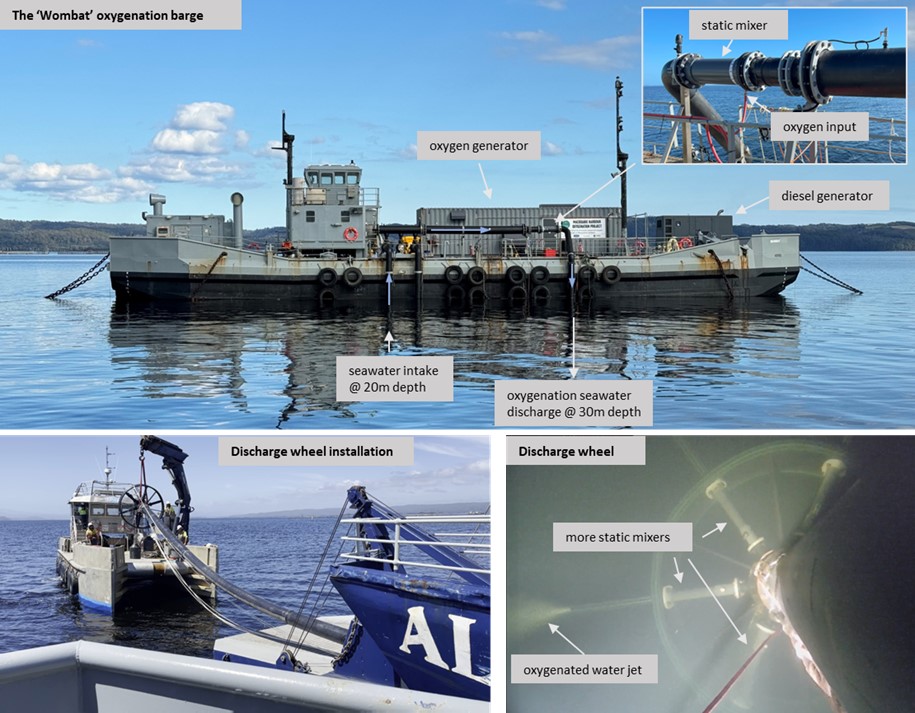
One of the most promising developments identified by the review is the growing interest in direct injection of pure oxygen at depth. One approach uses lines of diffuser hose to release oxygen into deeper water, allowing it to dissolve with less disturbance and more efficiency than large-scale mixing. This could potentially provide a way to move beyond the relatively small, enclosed systems where most marine EOS techniques have been applied to date. But scaling up brings its own challenges in terms of energy, infrastructure and cost. As a result, larger scale adoption of EOS techniques will require transparent economic and energy assessments alongside environmental monitoring.
The concept of putting oxygen back into depleted waters is both technically challenging and increasingly relevant as climate change and human activities continue to reshape freshwater and marine environments. When accompanied by comprehensive monitoring and economic assessment, EOS may represent a new tool to support the functioning of marine ecosystems and buy us time to address the main drivers at their source.
More information on the application of EOS in Macquarie Harbour can be found here.
The full review article can be accessed here.